Ramadan Nighaban Package 2026
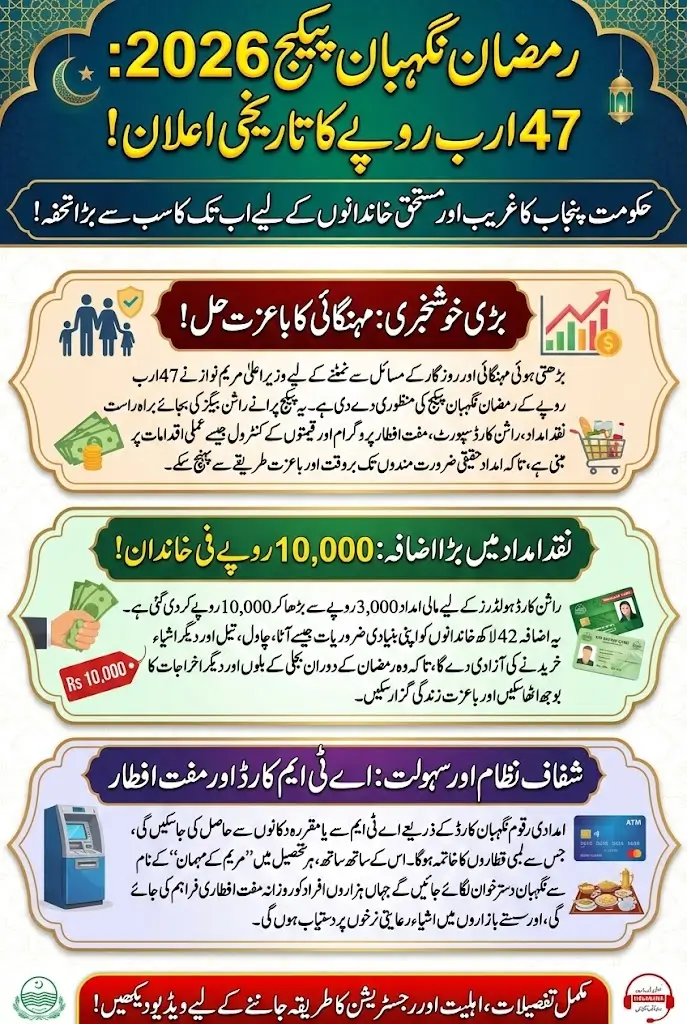
The Punjab government has officially approved the Rs 47 billion Ramadan Nighaban Package 2026 to support low-income families during the holy month. Chief Minister Maryam Nawaz took this decision in response to rising inflation, increasing food prices, and the growing financial pressure on daily wage earners across Punjab. For many households, managing sehri and iftar expenses has become extremely difficult, making this relief package both timely and necessary.
Unlike earlier schemes that relied heavily on ration bags, the Ramadan Nighaban Package 2026 follows a more practical and dignified approach. The government has combined direct cash assistance, ration card support, free iftar programs, and price control measures under one coordinated plan to ensure relief reaches deserving families without delays or misuse.
Background of the Ramadan Nighaban Package 2026
Ramadan is a month of spirituality and patience, but for low-income families it also brings financial stress. Increased food consumption, higher market demand, and limited income sources make it harder for poor households to meet basic needs. Keeping these realities in mind, the Punjab government designed the Ramadan Nighaban Package 2026 as a targeted welfare initiative rather than a symbolic announcement.
The focus of this program is to empower families through cash support so they can decide their own priorities. This approach respects personal dignity and avoids forcing families into fixed ration patterns that may not suit their needs. The use of existing government databases further strengthens transparency and efficiency.
You Can Also Read: 9999 Web Portal Pakistan – Complete Guide to Online CNIC Check
High-Level Approval and Government Commitment
The approval of the Ramadan Nighaban Package 2026 was granted during a high-level meeting chaired by Chief Minister Maryam Nawaz. The meeting reviewed Ramadan arrangements, welfare coverage, and administrative readiness across the province. Officials were instructed to ensure that assistance is delivered before Ramadan begins to avoid last-minute issues.
By allocating Rs 47 billion, the Punjab government demonstrated a strong commitment to public welfare. Departments were directed to work in coordination, prioritize transparency, and monitor implementation closely so that deserving families receive support without unnecessary hurdles.
Key Decisions Taken for Ramadan Relief 2026
The government finalized several major decisions to improve the effectiveness of Ramadan relief. Instead of launching scattered programs, all relief efforts were combined under one structured plan to reduce confusion and administrative delays. This unified approach makes it easier for citizens to understand and access the program.
The decisions also focused on long-term impact rather than short-term visibility. Cash transfers, food programs, and price control mechanisms were designed to complement each other and provide balanced relief throughout Ramadan.
• Increase in cash assistance for ration card holders
• Expansion of free iftar and subsidized food initiatives
You Can Also Read: CM Punjab Laptop Scheme 2026 Phase-II
Increased Cash Assistance for Ration Card Holders
One of the most significant changes under the Ramadan Nighaban Package 2026 is the increase in financial support for ration card holders from Rs 3,000 to Rs 10,000. In current economic conditions, the earlier amount was insufficient to support even a small family. The revised figure better reflects real market prices and household needs.
This increased assistance allows families to purchase essential items such as flour, rice, oil, pulses, fruits, and vegetables without relying on loans or charity. It also gives households flexibility to manage electricity bills and other urgent expenses during Ramadan.
Cash Support for 4.2 Million Families
Under this package, 4.2 million deserving families across Punjab will receive Rs 10,000 each. This wide coverage shows that the government is targeting large-scale relief rather than limited or selective assistance. The aim is to reduce financial pressure for millions of people during Ramadan.
Direct cash assistance has proven more effective than ration distribution in previous programs. It reduces delays, minimizes wastage, and allows families to manage their needs according to their own priorities.
| Feature | Details |
|---|---|
| Total Budget | Rs 47 Billion |
| Beneficiary Families | 4.2 Million |
| Assistance Per Family | Rs 10,000 |
| Coverage Area | All districts of Punjab |
You Can Also Read: CM Punjab Ration Card 2026: Complete Guide to Eligibility
Role of Nighaban Card and CM Ration Card
The Nighaban Card plays a central role in ensuring transparent and secure distribution of funds. Eligible families will receive assistance through ATM-enabled cards, allowing them to withdraw cash or make purchases from designated outlets without standing in long queues.
The CM Ration Card system is also being used to identify deserving families using existing data. This reduces verification delays and ensures that assistance reaches those who genuinely need it.
• Transparent beneficiary identification
• Faster and corruption-free fund distribution
Nighaban Dastarkhwan and Free Iftar Program
Alongside cash assistance, the Punjab government has approved the continuation of Nighaban Dastarkhwan under the title “Maryam Kay Mehman.” These dastarkhwans will operate in every tehsil and provide free iftar meals to thousands of people daily.
This initiative is especially helpful for laborers, travelers, and individuals without stable incomes. For many, these free meals become a lifeline during Ramadan and reflect the government’s focus on compassion and inclusion.
You Can Also Read: 8070 Registration Online 2026 for Muft Rashan & Rs 10,000
Sahulat Bazaars and Price Control Measures
Price hikes during Ramadan often place additional pressure on poor families. To control this issue, the Punjab government has approved Sahulat Bazaars across the province. These bazaars will offer essential items at subsidized rates under strict government supervision.
Based on past experience, Sahulat Bazaars help stabilize prices and reduce exploitation by middlemen. Dedicated monitoring teams and digital surveillance will ensure quality, cleanliness, and fair pricing.
| Relief Measure | Purpose |
|---|---|
| Sahulat Bazaars | Subsidized essential items |
| Nighaban Dastarkhwan | Free iftar meals |
| Digital Monitoring | Price and quality control |
You Can Also Read: 8070 Web Portal Registration 2026: Complete Guide to Rs. 10,000
Eligibility Criteria for Ramadan Nighaban Package 2026
Eligibility for the Ramadan Nighaban Package 2026 is determined using PSER and BISP databases. Priority is given to low-income households, daily wage earners, widows, and financially dependent individuals.
Applicants must be permanent residents of Punjab, have a valid CNIC, and fall within the government-defined income and poverty score limits. Families already registered in PSER or receiving BISP support are likely included automatically.
Registration and Status Check Methods
The government has provided multiple channels to check eligibility or register for the package. Citizens can use SMS services, online portals, helplines, or visit local offices for assistance. This multi-channel approach ensures access for both urban and rural populations.
Verification is conducted through NADRA and government records, and applicants are informed of their status via SMS. This reduces confusion and keeps the process transparent.
FAQs
What is the Ramadan Nighaban Package 2026?
It is a Rs 47 billion relief program providing cash assistance, free iftar, and subsidized food to low-income families in Punjab.
How much cash will each family receive?
Each eligible family will receive Rs 10,000 during Ramadan.
Who is eligible for this package?
Low-income Punjab residents meeting PSER and income criteria are eligible.
How will the cash be distributed?
Funds will be delivered through Nighaban Cards and authorized banking channels.
Are Sahulat Bazaars available in all districts?
Yes, Sahulat Bazaars will operate across Punjab under government supervision.
Conclusion
The Ramadan Nighaban Package 2026 is one of the largest welfare initiatives in Punjab’s history. By combining cash assistance, food support, and price control measures, the government has taken a comprehensive approach to easing the financial burden on low-income families.
If implemented effectively, this package can significantly reduce hardship during Ramadan and strengthen trust in transparent, digital governance. For millions of families, it offers not just financial relief, but dignity and peace of mind during the holy month.
You Can Also Read: PSER Online Registration 2026: Complete Guide